Not a newsletter. Not signals. Not a course.
A hedge fund trader's group chat — and you're in it.
01
What Is Autonomous
Follow markets with access to
a hedge fund trader.
Your direct line to a former hedge fund trader.
See what I'm watching. The analysis. The trades. Direct access to ask questions and learn.
Free answers what happened.
Insight answers what is
happening, why, and what is likely next.
Pro answers how I would trade
it. Elite gives you one-on-one access to me.
The goal is an inside look at how I actually trade, so one day
you won't need me.
What and how I am trading, and my timing. My full book, including the ones that go against me.Institutional read of traditional technical & fundamental indicatorsPredictive cross-asset macro, liquidity & flow modelsConfluence of both
— higher conviction, better alpha
as I take them
The Analysis and CommentaryInsight tier & up
Single stocks, every asset, every session — the names you trade, covered individually, alongside the index and the macro behind them.
Daily technical analysis on the most traded names — requests taken
Single stocks, one chart at a time: the structure, the levels and the read. Drop a ticker and I'll cover it.every session
Single-name and cross-asset analysis, plus sell-side research
My read on stocks and market themes through credit, rates and FX, alongside the actionable takeaways from JP Morgan and Goldman.as it lands
SPX game plan: index levels and commentary through the NY session
every NY session
The AccessElite tier only
Direct access to a hedge fund trader — ask questions, get coached, and have your trades reviewed weekly
Group calls, analysis walkthroughs and Q&A, with a recording afterwards.weekly
Insight gets the analysis and commentary. Pro gets the trades. Elite gets coached by an institutional trader.
Inside the chat
Follow the markets and trade with
access to a hedge fund trader.
You ask, I answer — and you
trade with more
confidence, because you know why the read exists, what
would break it, and what I am doing about it. That is the
difference between reading someone's analysis and sitting next
to the person making it. Not a signal to copy. A conversation.
Illustrative conversation · not a live feed
Autonomous Markets•#pro-chat
GEX just flipped negative
+ charm
turning bearish. no support until
6,820.
if6,850
breaks, short setup to
6,820–6,825.
why is 6,820 the next support?
there's a cluster of dealer long positions at
6,820
and it's a significant S/R line that's been tested
multiple times. expecting buying to show up there.
Daily macro, liquidity, and positioning analysis, gamma,
CTA flows, and dealer hedging, to help you understand
what's moving the market and what's likely to move next.
Expand the exampleExpandCollapse
Worked Example•from a recent session•SPX levels · ES execution
Three independent signals converged on one setup.
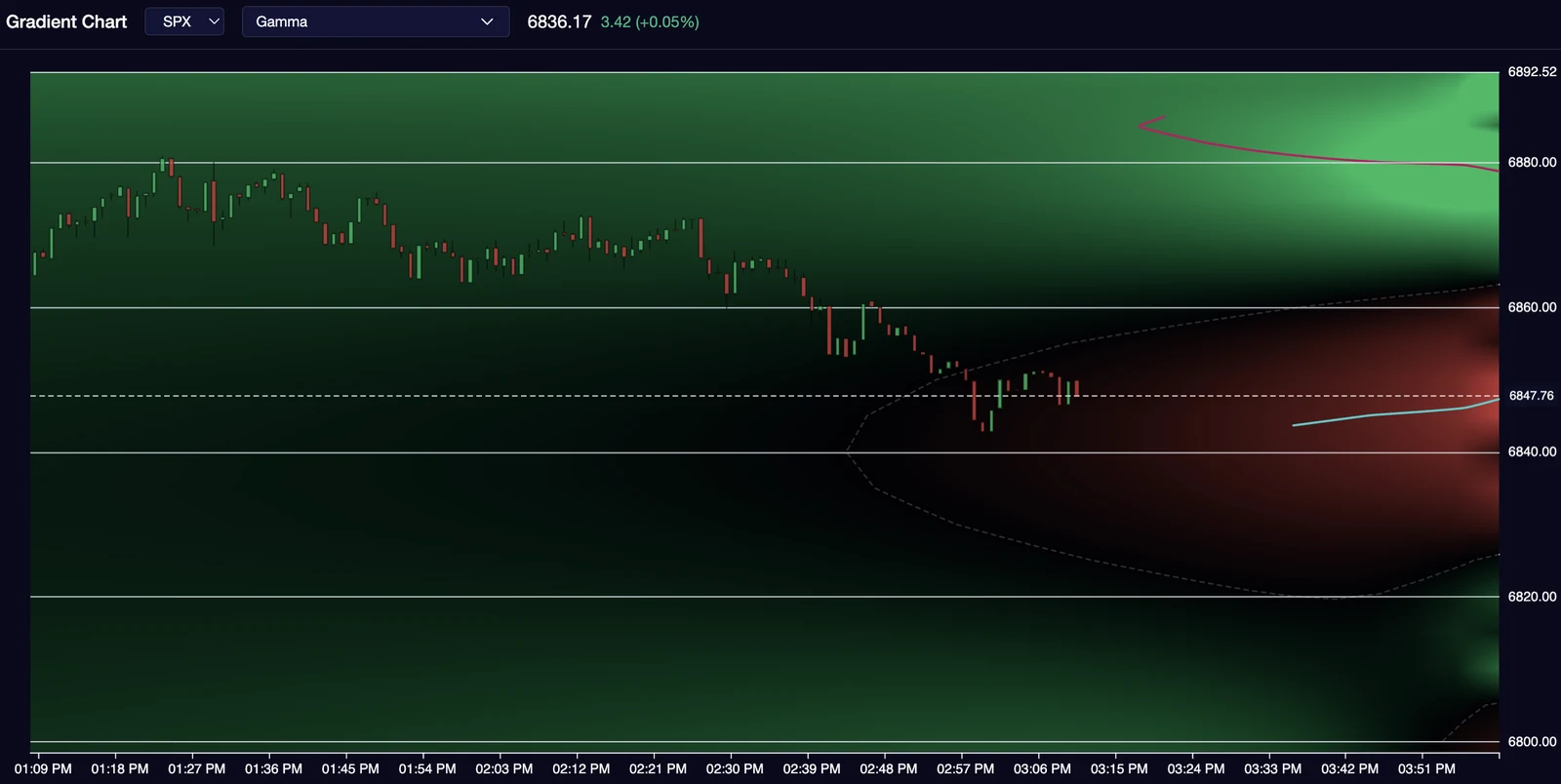
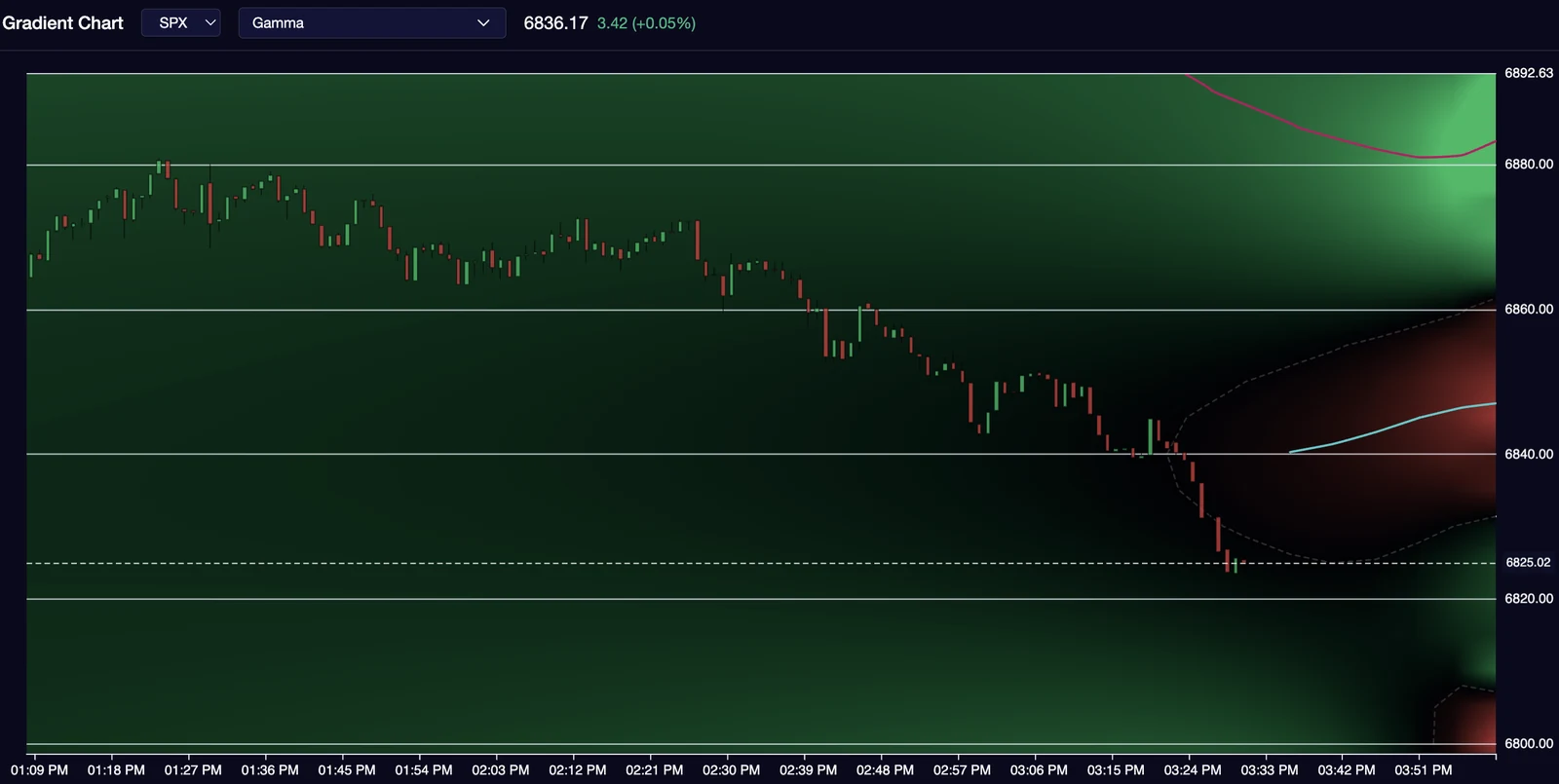
3:10 PMSignal 1•Gamma Exposure Flips Negative
Market makers transition into a negative
environment
(black/red shaded area). Dealers flip from cushioning price to
amplifying it.
Gamma
measures how fast an option's directional exposure
changes as price moves, and the dealers on the
other side of those options have to hedge it in
the futures market. While their gamma is positive,
that hedging fights price: they sell into rallies
and buy into dips, which pins the market in a
range. Once it flips negative, the same hedging
runs with price, selling into weakness and buying
into strength, so moves that would normally stall
accelerate instead.
In negative gamma
Moves
accelerate and follow through
Dealers are
forced to chase the move
Before
3:10 PM
After
3:30 PM
Chart
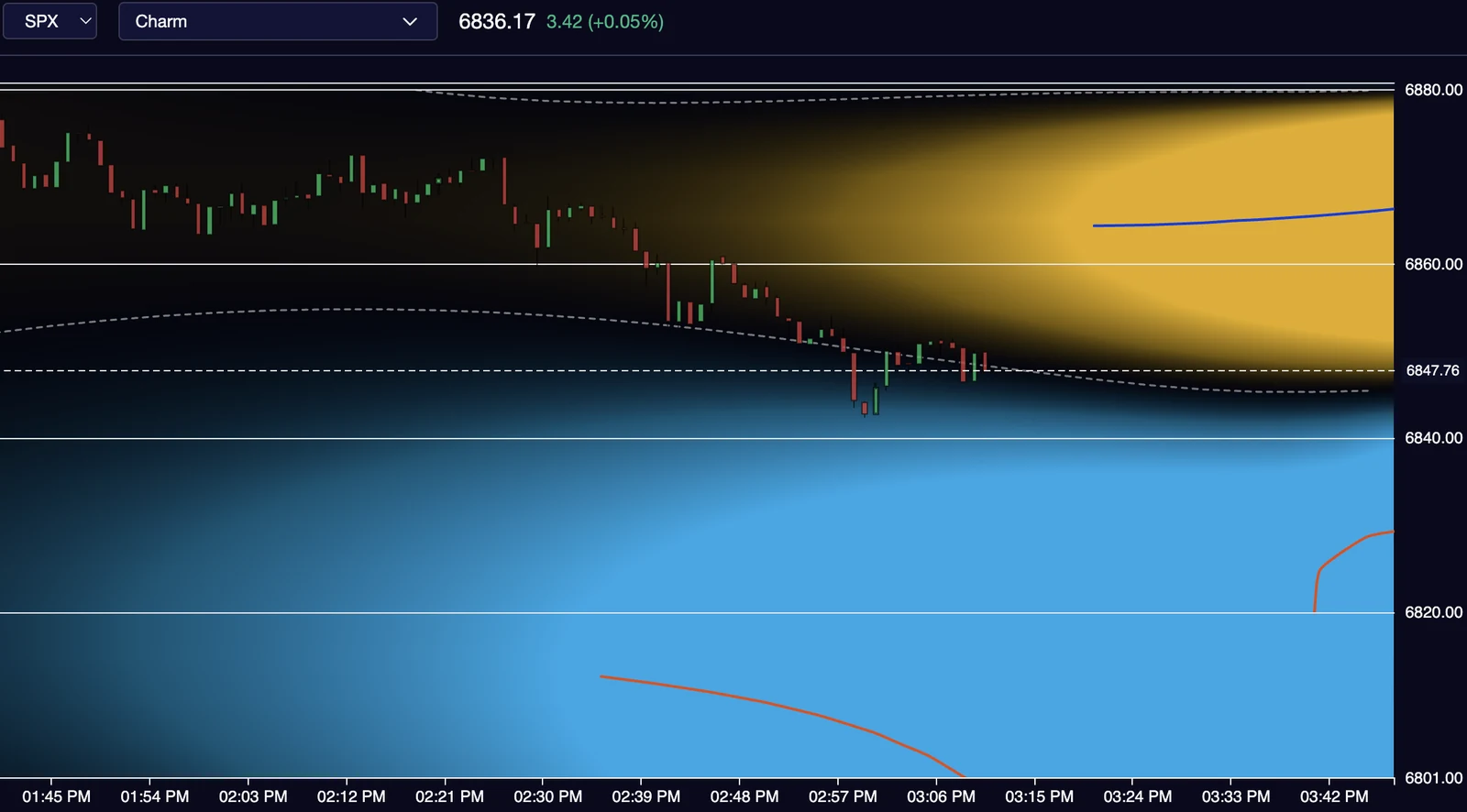
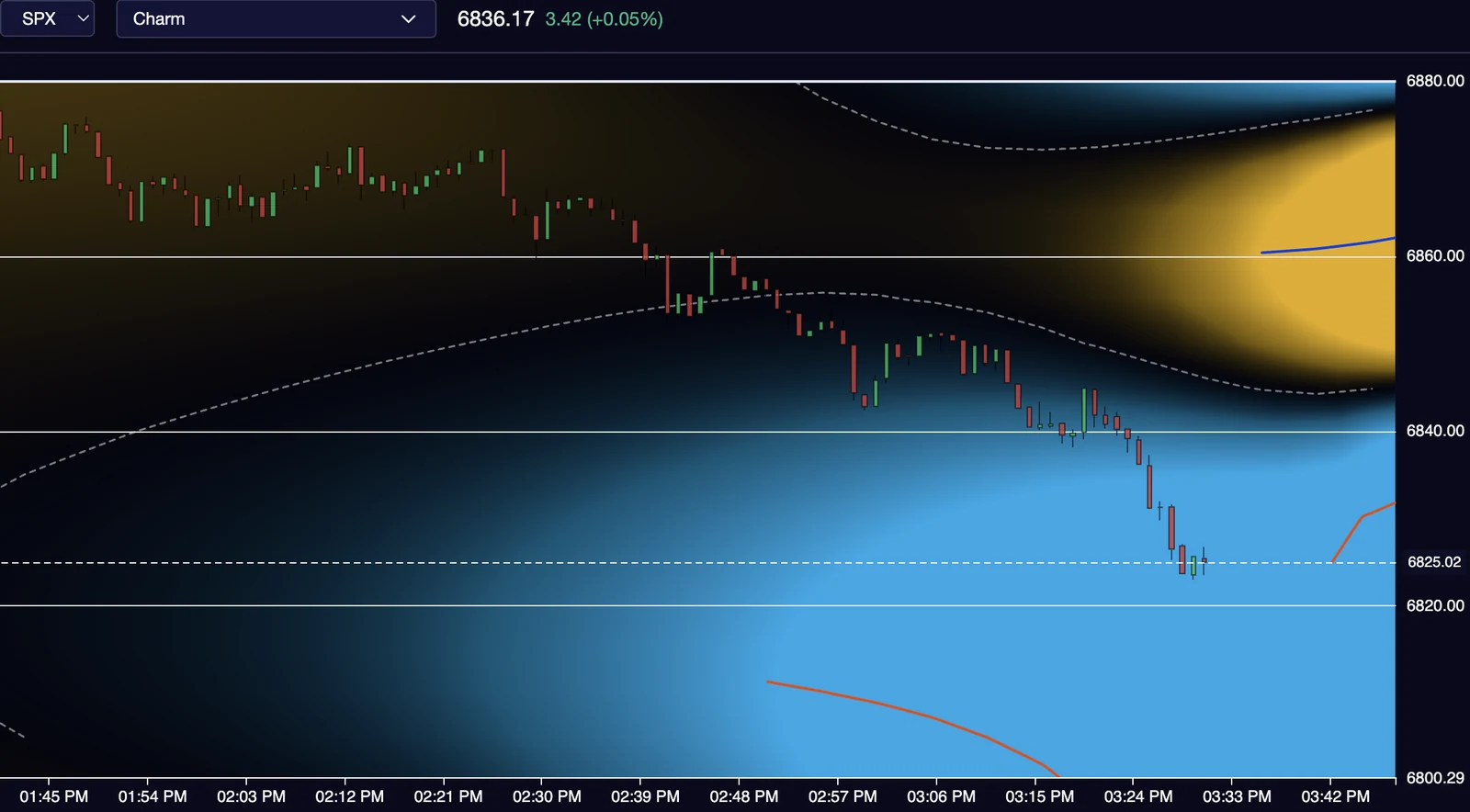
3:10 PMSignal 2•Charm Flips Bearish
Price crosses the
flip level.
Charm
measures how that same directional exposure
decays with the passage of time, even when price
sits still. Dealers hedge the drift, so the
clock itself produces a steady bid or offer in
futures that has nothing to do with news. Above
the flip level the decay forces dealers to buy,
quietly supporting price all session; below it
the mechanic reverses and they become passive
sellers into every bounce.
Implication
Market makers are now
passively selling futures
Hedging the change in delta as time
passes
Legend
Bearish charm: market makers have futures
for sale
Negative gamma
accelerates the move, so expect a fast slide
direction
SHORT
SPX price
6,847
target
6,820 – 6,825
Result•Levels read on SPX, executed in E-mini ES
move captured
+25
pts
SPX level
6,847 → 6,822
per ES contract
$1,250
at $50/pt
Called at 3:10 PM, target hit at 3:30. Twenty
minutes. Members had the levels before
the move.
One example, chosen because it shows the setup
clearly. Not a promise of profit.
Everything here is education, not signals. By the
time you read a post my risk may already have
changed.
Gamma and charm charts are screenshots from
VolSignals, a third-party data platform I subscribe to and
use in my own trading the way anyone uses a chart.
I am not affiliated with them and I do not resell
their data. What I publish is my read of it. If
you want the raw feed, subscribe to them directly.
Live Trading Desk on Discord
Pro gets my complete live read as setups develop, including when I sit out. Free gets selected analysis and education.
GEX just flipped negative
+ charm
turning bearish. no support until
6,820.
if6,850
breaks, short setup to
6,820–6,825.
why is 6,820 the next support?
there's a cluster of dealer long positions at
6,820
and it's significant S/R line that's been tested
multiple times. expecting buying to show up there.
Daily Market Color, Cross-Asset & Institutional Research
Every session: what is happening, what is driving it,
and what to watch next — with my view and my forecast
on each. Equities, rates, credit, FX and commodities read as
one tape,
with the positioning and liquidity underneath it. Plus what
other institutions are saying: my inbox, the notes JP Morgan
and Goldman send their clients, and what is actually
actionable in them.
The names I think are set up, before they move. Each idea
carries the thesis, the levels, the invalidation, and the
option structure that expresses it best given vol, gamma and
the cross-asset tape. Risk the premium, target three to four
times it.
SPXbearish
put fly financed by call cs
Closed+$2,500risked $500
No juice left on the upside, so I sold the Aug 6900/6950
call spread for $700. That credit paid most of a
6300/6400/6500 put fly that cost $1,200, so my real risk
was the $500 difference. Calls expired worthless. SPX
settled 6470, inside the wing, and the fly cashed at
$3,000. Risked $500 to make $2,500.
EntryBuy Aug 6300/6400/6500 Put Fly
$12.00 db + Sell Aug
6900/6950 CS $7.00
cr
Cost$5.00 net db
($500 max loss)
ExitCS expired worthless · Fly settled
$30.00
P&L+$2,500
(+500% on $500 risk)
r/r ratio5 : 1 realized
· 20 : 1 at the 6400 pin
Insight & up
Technical Analysis on the Most Popular Names
Every session, my read on the most traded names: the levels
that matter, the structure around them, which way I lean
— and what would prove me wrong. One chart at a time,
requests taken.
XYZbullish
#charts
postedevery session
Coming Soon
Course Library
Foundations through advanced flow analysis, plus weekly live
Q&A.
Not available yet — the courses are still in
development. Leave your email below and I’ll let you
know the moment they launch.
Coming Soon
Preview only
Want in when it launches? Leave your email.
You’re on the course list. I’ll email you
the moment it launches.
No spam. Unsubscribe anytime.
The Approach
Even a slight edge, held with discipline, outperforms.
Every edge in markets comes from one of three places, and a
retail account almost never has the first two.
So I teach both halves: the institutional way of reading a
market, traditional and non-traditional, and the trade
management and behaviour I learned from professionals.
One without the other does not survive contact with the tape.
Knowing something the market does not yet. Order flow, client positioning, the print before it hits the wire.
Institutions
02
Analytical
Processing public information better than everyone else. Quant teams, colocated servers, models that reprice a thousand names in a blink.
Institutions
03
Behavioral
Doing what everyone else cannot: sitting on your hands, sizing small, taking the loss, not chasing. It costs nothing and needs no desk.
Yours to own
02
Who Am I
a trader,
not an influencer.
Autonomous•Founder, Autonomous Markets
5+ yrs Institutional TraderActive Discretionary DesksHedge Fund Experience
01
Where I Worked
I spent 5+ years across numerous institutional desks at bulge bracket investment banks and hedge funds, trading real size with real risk.
I traded U.S. technology stocks for a thematic pod and covered investment-grade and high-yield corporate credit. Earlier in my career, I held junior roles covering and trading U.S. equity derivatives, swaps, and interest rate derivatives.
That's where I learned how markets move from the inside.
02
The Autonomous Difference
Most people selling trading education have never sat on a
trading desk.
They learned from YouTube and now teach what they learned there.
And the ones who have? Most followed a rules-based approach:
70% of fund traders follow an algorithm or strict system.
I was an active discretionary trader, making the kind of
decisions retail traders make every day.
I learned to do it properly because I had a seat at those desks.
Now I run a private investment and holding company, applying
those same frameworks. What I share here comes directly from
that work. Building a platform around it used to take more time
than I could justify. AI changed that. It handles the repetitive production tasks,
while I bring my expertise to the analysis.
I started Autonomous Markets because I kept watching
smart people get fed garbage by people who’d never traded.
And honestly, the competitive side of me knew I could do it
better.
03
My Approach
TacticalThematicIntraday0DTE
To drive execution across the tactical, thematic, intraday and
0DTE buckets, I deploy expertise in traditional technical and
fundamental indicators, coupled with a predictive cross-asset
macro framework
engineered to lead tape movement.
Rather than relying on lagging price indicators, my approach
systematically evaluates order flow mechanics, institutional
positioning, and market microstructure across equities, rates,
FX, and commodities.
I build custom in-house quantitative models to monitor options market structure and track dealer gamma exposure (GEX) in real time.
Volatility regimes & inflection points
This maps shifting volatility regimes and pinpoints structural inflection points where market maker delta/gamma hedging either dampens price action or triggers explosive feedback loops.
02Systematic Flow Tracking
Follow the flows that move markets.
Systematic positioning
I pair dealer delta and gamma modeling with real-time estimates of systematic positioning across the rules-based complex — CTA trend-followers, vol-target and risk-parity mandates, and other mechanical programs.
Buying & selling triggers
This lets me map de-leveraging and re-leveraging trigger levels, anticipating price-insensitive buying and selling ahead of major market moves.
03Cross-Asset Risk & Liquidity Triad
Connect the signals across markets.
Credit, rates & liquidity
I synthesize real-time shifts in credit spreads, global yield curves, and macroeconomic liquidity metrics alongside fixed income volatility and equity dispersion.
Stress & relative value
Monitoring this cross-asset framework exposes underlying financial stress and relative-value dislocations before they surface in benchmark index pricing.
I wait for all or most of the signals derived from these frameworks to converge into one insight. I share the insights from all this analysis with you and teach you how to do it yourself and trade it in the membership.
What members say
"
"My time overlapped with Autonomous at a trading desk I
worked at. There's probably no one better to teach this
stuff because he saw how markets move at a level most people
never get access to."
Institutional Trader for 11+ years
Former Colleague, Institutional Desk
"
"I've learned a lot from simply reading autonomous's takes"
X Follower since March 2022
@Mrconcerto
"
"The free content he posts alone is better than courses I've
paid money for"
Discord Member
@blintio21
"
"My time overlapped with Autonomous at a trading desk I
worked at. There's probably no one better to teach this
stuff because he saw how markets move at a level most people
never get access to."
Institutional Trader for 11+ years
Anonymous
"
"I've learned a lot from simply reading autonomous's takes"
X Follower since March 2022
@Mrconcerto
"
"The free content he posts alone is better than courses I've
paid money for"
Discord Member
@blintio21
03
Pricing
Pick your
seat.
Four tiers, one Discord: a seat next to a hedge fund trader.
Free answers what happened. Insight answers
what is happening, why, and what is likely next. Pro answers
how I would trade it. Elite gives you one-on-one access to me — weekly group
calls, analysis walkthroughs, Q&A and recordings.
Paid plans start at $19/mo. Pro at $39/mo is less than a 1-point move on a single /ES contract. All prices in USD, billed monthly.
Start here
Free
Market Overview & Community
What happened
$0
/month
Daily market updates and week-ahead prep. Completed
trades, broken down. The community.
For the trader who wants to see how I think before paying
to see what I do.
Breakdowns are retrospective — the trade has already played out.
Completed trades, broken down — original timestamps
shown
The community: discussion, questions and answers
General analysis and educational chart examples, posted
ad hoc
The frameworks, taught through completed-trade examples
Public lessons and selected replays; Elite sessions stay
in Elite
Go deeper
Insight
Research & Analysis
What’s happening, why — and what’s next
$19
/month
Full analysis, charts, cross-asset frameworks and market preparation — indices and single stocks alike, and the reasoning behind my market view.
For the trader who wants to know what is driving the narrative, what is likely to happen next, and which single names it shows up in — a direct line into a hedge fund trader's group chat.
Thematic, cross-asset analysis: themes, single names, macro, positioning
Daily technical analysis on the most traded names, requests taken
My view, my forecasts, and the scenarios behind them
What is driving the tape and what to watch, with my read on it
Sell-side equity research, raw, plus my plain-English decode
The frameworks themselves, taught: macro, gamma, CTA flows and dealer hedging
Recommended
Pro
Analysis & Actual Trades
How I’m trading it
$39
/month
Everything in Insight, plus the trades themselves:
what and how I am trading, and my timing — entries,
adjustments, trims, position updates and exits. My full
book, including the ones that go against me.
For the trader who wants to see the trade, not just the
thesis: the structure, the entry, the invalidation
— and what I actually did about it.
What and how I am trading, and my timing: entries,
adjustments, trims, updates and exits, plus every trade
idea from the desk
My read in real time, all session: the standing view &
multi-day thesis
SPX session game plan: index levels and commentary all
NY session
Execution frameworks: structuring a trade for the most
asymmetric payoff
Reading the volatility surface: whether to express a view
in options at all, and which structure
The members room: smaller, sharper, no noise
Full access
Elite
Full Access & Group Coaching
Access to an experienced trader
$99
/month
Everything in Pro, plus: regular access to a hedge fund
trader — consult on your own trades, work with me on your
development as a trader, or just pick my brain, through
weekly group calls, one-on-one sessions, analysis
walkthroughs and Q&A.
For the trader who wants the reasoning, not just the
read: bring your own trades and questions, and work
through them with me.
Video calls and group coaching: bring your questions and work through the analysis with me
Step-by-step walkthroughs of the thesis, key levels, risk and trade management
One-on-one sessions and direct access to me for guidance and questions
Weekly reviews of your trades
The desk's indicators, dashboards & templates
Live audio through the open, plus deep dives, webinars and open AMAs
Weekly office hours: bring your questions, live with me
One scheduled group call each week, with a recording afterward. Bring questions in advance. One-on-one time is by arrangement and subject to availability; membership does not include unlimited private messages, guaranteed individual attention or account management.
The real product is the seat: a hedge fund trader
looking at your process and telling you what to improve.
Free
Insight
Pro
Elite
Deeper market analysis & the reasoning behind the view
Cancel anytime. Access runs to the end of your billing period.
Everything here is education, not signals: posts document my process
so you learn to run your own. By the time you read one, my risk may
already have changed. Sizing and execution are always yours.